
Dark Factor in Budgerigars, The 1:2:1 Ratio Explained
Autosomal incompletely dominant · Each copy darkens the body · 0 copies = Light Green / Sky Blue, 1 copy = Dark Green / Cobalt, 2 copies = Olive Green (Olive) / Mauve

TL;DR
The Dark Factor is an autosomal incompletely dominant gene that darkens the body colour of budgerigars. Zero copies gives Light Green or Sky Blue. One copy (Dd, heterozygous) gives Dark Green or Cobalt. Two copies (DD, homozygous) gives Olive Green (Olive) or Mauve. Because the gene is incompletely dominant, every copy is visible, meaning Cobalt × Cobalt produces the famous 1:2:1 ratio of Sky Blue : Cobalt : Mauve offspring. Dark Factor is independent of the Blue/Green locus, so it stacks on both base series.
Try these pairings instantly
→ Cobalt x Cobalt = 1:2:1 (textbook)→ Sky Blue x Mauve→ Dark Green x Sky BlueWhat is Dark Factor?
The Dark Factor is a gene that physically alters how feathers reflect light by narrowing the spongy (Tyndall) zone in the feather barbs. The narrower this zone, the darker the body colour appears, not because of extra melanin, but because of differential light scattering. This is documented in Dirk Van den Abeele's research and is the modern correction to the older theory that Dark Factor adds eumelanin.
Each Dark Factor allele (D) shifts the body colour one shade deeper. The wild-type allele (d) keeps the colour at its lightest.
The 6 base colour names budgies use
Dark Factor stacking on both base series
| Dark Factor genotype | Green Series | Blue Series |
|---|---|---|
| dd (zero copies) | Light Green | Sky Blue |
| Dd (one copy / SF) | Dark Green | Cobalt |
| DD (two copies / DF) | Olive Green (Olive) | Mauve |
Notice the colour escalation in both series: Light → Dark → Olive / Olive Green on the green side, Sky Blue → Cobalt → Mauve on the blue side. These six base names correspond to three Dark Factor states crossed with two Blue/Green-locus states.
The famous 1:2:1 ratio, Cobalt × Cobalt explained
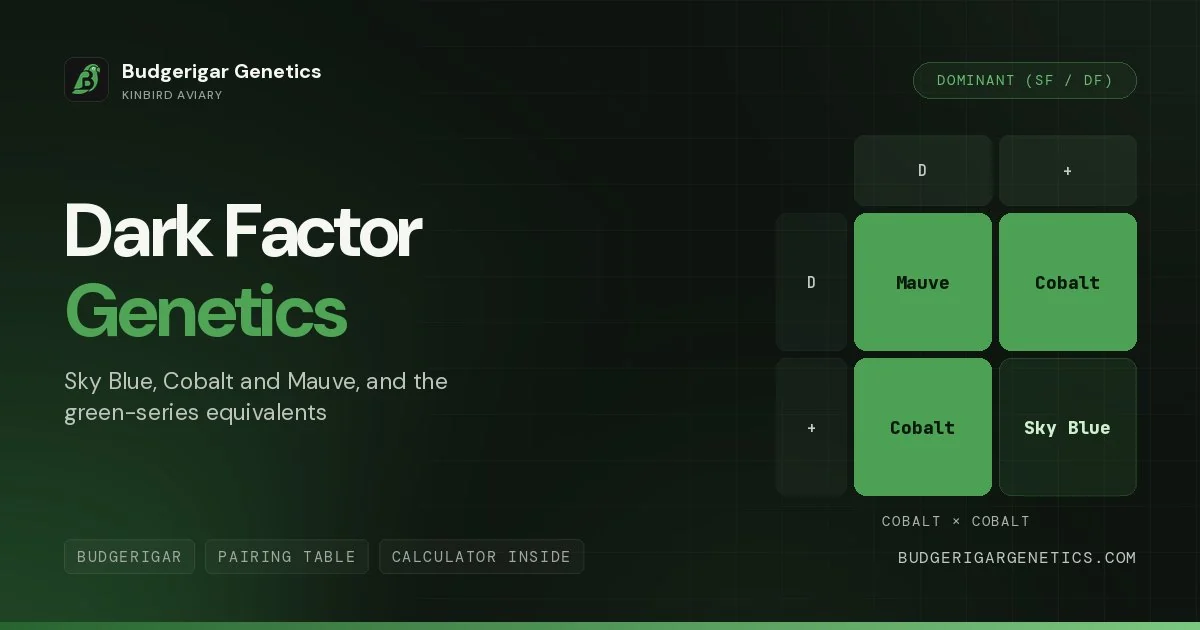
Because Dark Factor is incompletely dominant, every copy is visible. So two Cobalt parents (both Dd) produce offspring in a 1:2:1 Mendelian ratio:
- 25% dd (Sky Blue), no Dark Factor inherited
- 50% Dd (Cobalt), one Dark Factor inherited from one parent
- 25% DD (Mauve), two Dark Factors, one from each parent
This is the same ratio you would see if you paired any two SF carriers of an incompletely dominant gene, it is the classic teaching example of incomplete dominance in introductory genetics.
All Dark Factor pairings, full table
Pairing Outcomes (Blue series shown, Green works the same)
| Pairing | Sky Blue (dd) | Cobalt (Dd) | Mauve (DD) |
|---|---|---|---|
| Sky × Sky | 100% | 0% | 0% |
| Sky × Cobalt | 50% | 50% | 0% |
| Cobalt × Cobalt | 25% | 50% | 25% |
| Sky × Mauve | 0% | 100% | 0% |
| Cobalt × Mauve | 0% | 50% | 50% |
| Mauve × Mauve | 0% | 0% | 100% |
Why Violet on Cobalt is the show variety (formerly "Visual Violet")
Although Violet is a separate gene from Dark Factor, the most visually striking violet budgie is technically a Cobalt (Dd) carrying the Violet factor (Vv or VV). The single dark factor + violet combination produces the deep violet hue most breeders consider the show-quality violet, historically called "Visual Violet" by exhibition breeders. The calculator now labels these birds uniformly as Violet Cobalt (SF) and DF Violet Cobalt for consistency. Violet on Sky Blue (no dark factor) gives a paler "Violet Sky Blue", less striking. Violet on Mauve (two dark factors) gives "Violet Mauve", very dark, almost charcoal-violet. The calculator handles each combination automatically.
Why Dark Factor is the easiest mutation to plan
Because Dark Factor inheritance follows pure Mendelian incompletely dominant rules with no sex-linkage and no lethal alleles, the outcomes are 100% predictable. Breeders use Dark Factor as their main way to introduce subtle colour variation into a line without sex-linked complications (like Ino on hens) or recessive split-tracking headaches.
History & origin
The Dark Factor was first identified in Berlin, Germany, in 1915, making it one of the oldest documented budgerigar mutations after the discovery of the original Blue mutation. The earliest Cobalt and Mauve budgerigars appeared in continental Europe and quickly spread through the budgerigar fancy worldwide.
Predict any Dark Factor pairing instantly
The Budgerigar Genetics Calculator embeds Dark Factor directly into the base colour name (Light Green / Dark Green / Olive Green, Sky Blue / Cobalt / Mauve) so you can pick exactly the right starting genotype for each parent. The 1:2:1 ratio and every other Dark Factor outcome is computed automatically.
Open the Calculator →References
- Martin, T. (2002). A Guide to Colour Mutations and Genetics in Parrots. ABK Publications, Tweed Heads NSW. ISBN 978-0-9577024-7-9.
- Rogers, C. H. (revised by Blake, J.). World of Budgerigars. Beech Publishing House. ISBN 978-1-85736-270-1.
- Van den Abeele, D. Lovebird Compendium (Dark Factor mechanism / spongy zone). Belgium.
- Wikipedia: Budgerigar colour genetics, Dark factor.
Further reading: Inte Onsman MUTAVI Research · Dr. Terry Martin (2002), ABK Publications
Browse by inheritance type: Sex-Linked (6) · Autosomal Recessive (11) · Autosomal Incomp. Dominant (10) · Guides & Tools (10)
Continue reading


© 2026 KinBird Aviary · budgerigargenetics.com · Sister site: Lovebird Genetics