
Ino Budgerigar, Lutino & Albino Genetics
Sex-linked recessive · Removes all melanin · Lutino (green base) / Albino (blue base) · Red eyes

TL;DR
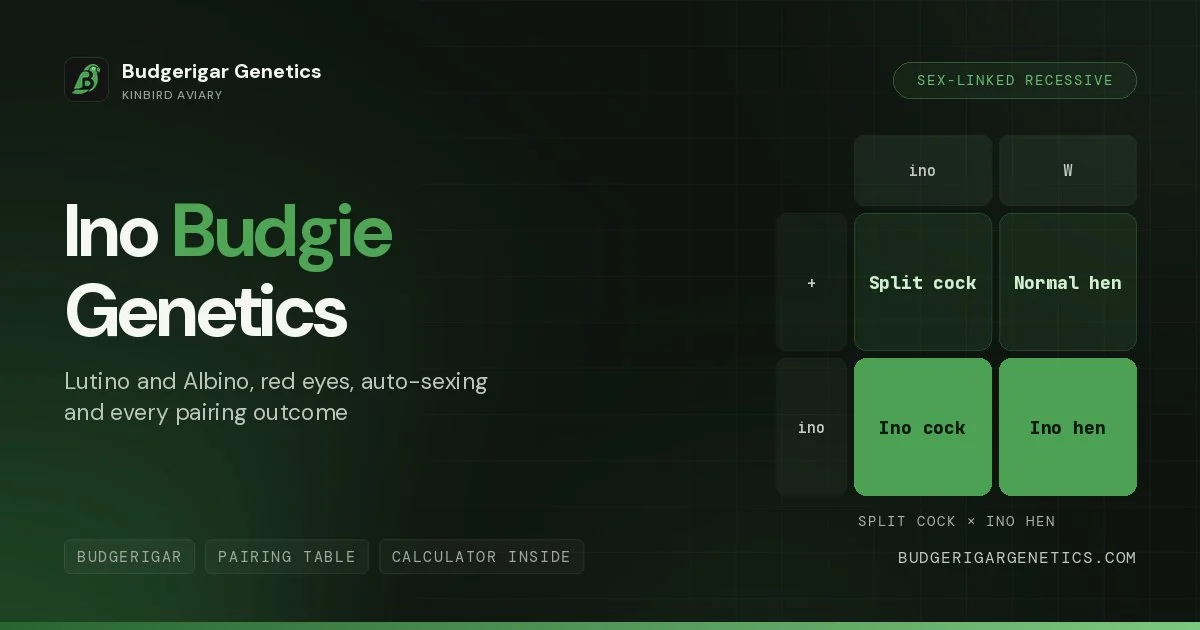
Ino is a sex-linked recessive mutation in budgerigars that removes all melanin pigment from the feathers. On a green-series base the result is a pure-yellow bird called Lutino; on a blue-series base the result is a pure-white bird called Albino. Both have red eyes. In budgies, Ino sits on the Z chromosome, this is critical because in lovebirds the Ino gene is autosomal, meaning lovebird and budgie Ino calculators are not interchangeable. Cocks can be split for Ino; hens cannot.
Ino at a glance
| Inheritance | Sex-linked recessive (Z chromosome) |
|---|---|
| Copies needed to show | Cocks need two copies, hens need one |
| Split carriers | Cocks only. Hens cannot be split |
| Calculator settings | Visual or / Split for cocks, Visual only for hens |
| Where to find it | Mutation list, Sex-Linked group |
QUICK ANSWER
Ino at a Glance
- Inheritance: Sex-linked recessive, carried on the Z chromosome.
- What it does: Removes all melanin pigment from the feathers.
- Lutino: Ino on a green-series base: a pure yellow bird with red eyes.
- Albino: Ino on a blue-series base: a pure white bird with red eyes.
- Cocks can be split, hens cannot: A cock is ZZ and carries two copies, so he can hide one. A hen is ZW with a single Z, so she is either visual Ino or she is not.
- Auto-sexing pairing: An Ino cock paired to a normal hen gives split cocks and visual Ino hens, so the chicks can be sexed by sight in the nest.
- Budgie Ino is not lovebird Ino: In budgerigars Ino is sex-linked. In lovebirds the Ino gene is autosomal, so a lovebird calculator returns the wrong answer for a budgie pairing.
- Lacewing: Cinnamon and Ino crossing over on the same Z chromosome.
PLAIN ANSWER
Is My Budgie a Lutino or an Albino?
- Is my yellow budgie a Lutino?: A Lutino is solid yellow with no wing markings, no throat spots, white cheek patches and red eyes. If the eyes are dark, it is not a Lutino.
- Is my white budgie an Albino?: An Albino is solid white with no markings and red eyes. It is the same Ino gene as Lutino, sitting on a blue-series bird instead of a green one.
- Do albino budgies have blue eyes?: No. Albino budgerigars have red or pink eyes, because Ino removes the melanin that would otherwise darken the iris. A white budgie with blue or dark eyes is a different mutation, usually a double factor Spangle or a Dark-Eyed Clear.
- Can an albino budgie be yellow?: Not a true Albino. If a mostly white bird carries yellow on the face or flanks, it is a Yellow Face or Goldenface Albino — the Ino removes body melanin while the yellow-face gene keeps the mask.
- Lutino versus Dilute versus double factor Spangle: All three can look yellow. Lutino has red eyes and no markings at all. Dilute keeps faint ghost markings and dark eyes. Double factor Spangle is near-clear with dark eyes.
- Can you sex a Lutino or Albino chick?: Yes, if the father is Ino and the mother is normal. Every daughter will be visually Ino and every son will be a normal-looking split, so the chicks sex themselves in the nest.
- Why hens cannot be split for Ino: Ino sits on the Z chromosome. A cock is ZZ and can hide one copy. A hen is ZW with a single Z, so she is either Ino or she is not.
Try these pairings instantly
→ Lutino cock x Normal hen (auto-sex)→ Albino cock x Sky Blue hen→ Split Ino cock x Normal henWhat is Ino in budgerigars?
Ino removes all eumelanin (black) and phaeomelanin (brown) pigments from the bird's plumage and eyes. The yellow base pigment (psittacin) is retained on green-series birds, producing the rich golden-yellow Lutino. On blue-series birds, which already lack the yellow base pigment, the result is pure white, Albino. In both forms, the absence of melanin means the eyes appear red (light reflecting off the blood vessels of the retina), and the legs and beak are typically pale.
Why is Ino sex-linked in budgies but autosomal in lovebirds?
This is one of the most important differences in psittacine genetics, and it trips up many breeders who cross-apply lovebird inheritance rules to budgies. In budgerigars, the Ino locus sits on the Z sex chromosome, making it sex-linked recessive. In peach-faced lovebirds, the Ino locus sits on an autosome, making it autosomal recessive. The visible phenotype (full melanin removal, red eyes) looks similar in both species, but the inheritance behaviour is fundamentally different.
Practical consequence: a hen budgerigar can never be "split for Ino." She is either visual Ino (Lutino or Albino) or normal. In contrast, lovebird hens absolutely can be split for Ino, the gene is autosomal in their species.
Pairing Outcomes, Quick Reference
| Pairing (cock × hen) | Cock offspring | Hen offspring |
|---|---|---|
| Visual Ino × Normal | 100% Split Ino | 100% Visual Ino |
| Split Ino × Normal | 50% Normal / 50% Split | 50% Normal / 50% Visual |
| Normal × Visual Ino | 100% Split Ino | 100% Normal |
| Visual Ino × Visual Ino | 100% Visual Ino | 100% Visual Ino |
| Split Ino × Visual Ino | 50% Visual / 50% Split | 50% Visual / 50% Normal |
Lutino vs Albino, what's the difference?
They are the same gene producing the same effect, only the base colour series differs:
- Lutino: Ino on a green-series base. The yellow psittacin pigment shows through unmodified by melanin. Body is pure golden-yellow, often with subtle "ghost" markings.
- Albino: Ino on a blue-series base. With both melanin and yellow pigment absent, the bird is pure white. Includes Sky Albino, Cobalt Albino, and Mauve Albino (these look almost identical to the human eye but track different blue-series alleles for further breeding).
A Lutino paired with an Albino can produce either Lutino or Albino offspring depending on which blue/green-series alleles the chick inherits. The calculator handles this correctly because it tracks base colour and Ino as separate gene loci.
Ino combinations breeders watch for
- Opaline Ino: Opaline is hidden by Ino because all melanin (which Opaline rearranges) is gone, but the Opaline allele still passes to offspring.
- Cinnamon Ino: The classic Lacewing crossover product. When Cinnamon and Ino sit on the same Z chromosome, the visible result is Lacewing, yellow/white body with brown wing markings (instead of the normal Ino's complete absence of pattern). See the dedicated Lacewing entry on the blog.
- DF Spangle Lutino lookalike: DF Spangle is sometimes mistaken for Lutino. The tell is the eye colour, Lutino has red eyes, DF Spangle has normal dark eyes.
History & origin
The first recorded Ino budgerigars were documented in continental Europe in the 1930s, with the mutation spreading rapidly through UK and US aviaries by the 1940s. Lutino became commercially popular ahead of Albino because the rich golden-yellow was visually striking on its own. Both are now among the most common pet budgerigar mutations worldwide.
Ino pairing outcomes, cock × hen
Every standard Ino pairing and what it produces. Tap Try it to open the exact pairing in the calculator with both parents already set.
| Cock | Hen | Sons | Daughters | Calculator |
|---|---|---|---|---|
| Visual Ino | Normal | 100% split | 100% visual | Try it |
| Normal | Visual Ino | 100% split | 100% normal | Try it |
| Visual Ino | Visual Ino | 100% visual | 100% visual | Try it |
| Split Ino | Normal | 50% split, 50% normal | 50% visual, 50% normal | Try it |
| Split Ino | Visual Ino | 50% visual, 50% split | 50% visual, 50% normal | Try it |
Percentages are within each sex. Hens cannot be split for Ino, so a daughter either shows it or does not carry it. A visual Ino cock with a Normal hen is the classic auto-sexing pairing: every daughter shows Ino, every son is split. When a split cock is paired with a Normal hen, the calculator marks his split sons with // because they look the same as their Normal brothers.
Breeder warning
Hens cannot be split for Ino. A hen either shows it or does not carry it, so a "split Ino hen" in a sale listing is a mistake. Only cocks can carry Ino hidden. Ino also hides other mutations: an Ino bird can carry Opaline, Cinnamon or Spangle without showing them.
Predict any Ino pairing instantly
Try the Budgerigar Genetics Calculator: pick the cock and hen base colours, add Ino (Visual or Split for cocks, Visual or Normal for hens), and the engine outputs the sex-separated offspring odds in seconds, including Lutino / Albino renaming on the relevant base colours.
Open the Calculator →References
- Martin, T. (2002). A Guide to Colour Mutations and Genetics in Parrots. ABK Publications, Tweed Heads NSW. ISBN 978-0-9577024-7-9.
- Rogers, C. H. (revised by Blake, J.). World of Budgerigars. Beech Publishing House. ISBN 978-1-85736-270-1.
- Onsman, I. Pigmentation in Psittacines. MUTAVI Research & Advice Group.
- Wikipedia: Lutino mutation.
Browse by inheritance type: Sex-Linked (6) · Autosomal Recessive (11) · Autosomal Incomp. Dominant (10) · Guides & Tools (10)
Continue reading


© 2026 KinBird Aviary · budgerigargenetics.com · Sister site: Lovebird Genetics