
Opaline Budgerigar, Complete Genetics Guide
Sex-linked recessive · Origin: Australia, 1933 · Affects wing markings and body colour distribution

TL;DR
Opaline is a sex-linked recessive mutation in budgerigars. The body colour extends onto the wings, the V-shaped saddle behind the neck disappears, and wing markings become clearer. Cocks can be split (carrier without showing); hens cannot, they are either visual Opaline or normal. First documented in Australia in 1933. Pairing an Opaline cock with a normal hen produces 100% split Opaline cocks and 100% visual Opaline hens, the famous "auto-sex" rule for sex-linked mutations.
Opaline at a glance
| Inheritance | Sex-linked recessive (Z chromosome) |
|---|---|
| Copies needed to show | Cocks need two copies, hens need one |
| Split carriers | Cocks only. Hens cannot be split |
| Calculator settings | Visual or / Split for cocks, Visual only for hens |
| Where to find it | Its own selector next to Bird Series on each parent card |
QUICK ANSWER
Opaline at a Glance
- Gene symbol: op.
- Inheritance: Sex-linked recessive, carried on the Z chromosome.
- Visual signature: Body colour extends up onto the wings and the wing markings become clearer, leaving a distinctive V of clear feathering between the wings.
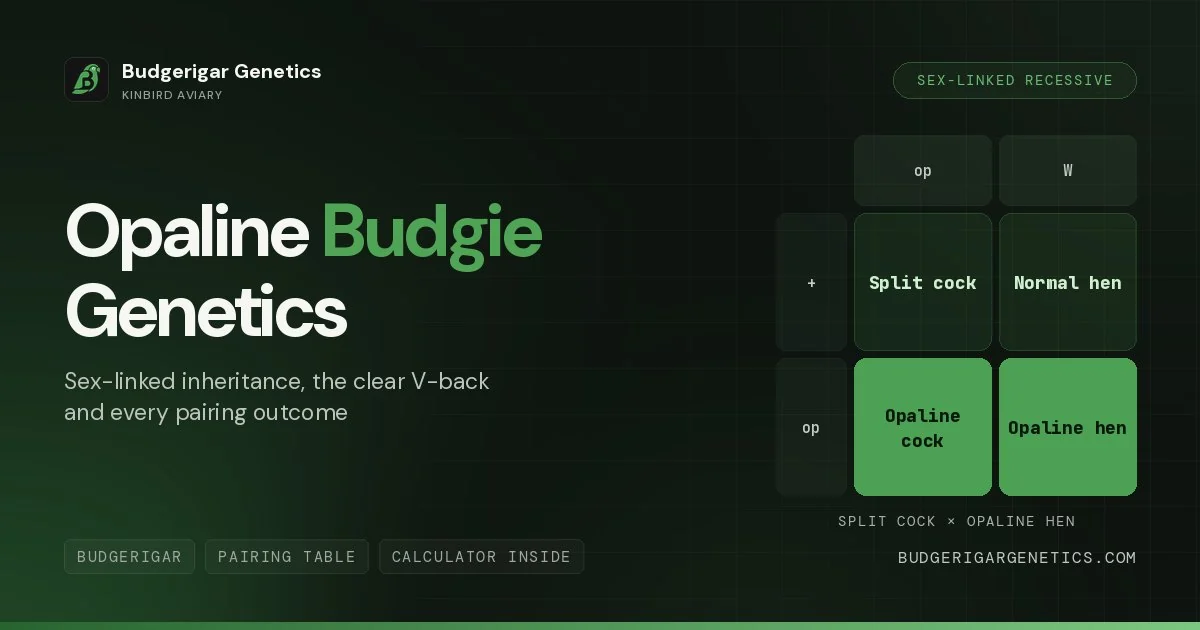
- Pairing math: Sex-linked recessive. A cock (ZZ) can be split; a hen (ZW) cannot — she is either visual or she is not. Split cock × normal hen gives visual hens and split cocks.
- Cocks vs hens: A cock can be split for Opaline and look completely normal. A hen has one Z, so she shows it or she does not.
- Auto-sexing use: Opaline cock × normal hen produces visual Opaline hens and normal-looking split cocks, letting you sex chicks by sight.
- Common combination: Opaline Cinnamon, both sex-linked, can cross over on the same Z chromosome.
PLAIN ANSWER
What Does an Opaline Budgie Look Like?
- The quickest way to spot one: Look at the back between the wings. An Opaline has a clear V-shaped patch of body colour there, where a normal budgie has black-and-yellow barring.
- Wing markings: Opaline wing markings are lighter and more open than a normal bird's, and body colour washes up into the wing instead of stopping at the shoulder.
- Head and neck: The barring on the head and neck is reduced, so the mask looks larger and cleaner and the throat spots stand out more.
- Opaline is not a colour: It is a pattern gene. An Opaline can be any base colour — Opaline Sky Blue, Opaline Light Green, Opaline Cobalt and so on.
- Cocks can hide it, hens cannot: Opaline is sex-linked. A cock can be split for Opaline and look completely normal. A hen has one Z chromosome, so she either shows it or she does not.
- Opaline Cinnamon: Both genes sit on the same chromosome and can cross over, which is why Opaline Cinnamon birds appear and why breeders track them as a pair.
Try these pairings instantly
→ Opaline cock x Normal hen (auto-sex)→ Split Opaline cock x Normal hen→ Opaline x OpalineWhat is the Opaline budgerigar?
The Opaline mutation alters how pigment is distributed across the budgerigar's plumage. In a normal budgie, the back of the neck and the saddle area carry a distinctive V-pattern of dark markings, the so-called "opalescent zone." In an Opaline budgie, the body colour (green or blue) extends right up over the back of the head and onto the wings, replacing much of the dark V-pattern with the body colour. Wing markings become clearer and more sharply defined against the lightened wing background.
Opaline is one of the four sex-linked recessive mutations in budgerigars, alongside Ino, Cinnamon, Slate, and Lacewing. It is among the most common and economically important budgerigar mutations because it combines beautifully with virtually every other mutation, multiplying the visual variety achievable in a breeding programme.
How is Opaline inherited?
Opaline sits on the Z sex chromosome. Cocks are ZZ, hens are ZW. Because the W chromosome carries no Opaline allele, the rules are:
- Cock (ZZ): can be normal (no Opaline allele), split Opaline (one Opaline allele, carrier, visually normal), or visual Opaline (two Opaline alleles).
- Hen (ZW): can be normal (no Opaline) or visual Opaline (one Opaline allele on her Z). Hens cannot be split for any sex-linked mutation.
Pairing Outcomes, Quick Reference
| Pairing (cock × hen) | Cock offspring | Hen offspring |
|---|---|---|
| Visual Opaline × Normal | 100% Split Opaline | 100% Visual Opaline |
| Split Opaline × Normal | 50% Normal / 50% Split | 50% Normal / 50% Visual |
| Normal × Visual Opaline | 100% Split Opaline | 100% Normal |
| Visual Opaline × Visual Opaline | 100% Visual Opaline | 100% Visual Opaline |
| Split Opaline × Visual Opaline | 50% Visual / 50% Split | 50% Visual / 50% Normal |
Why is Opaline "auto-sexing"?
The single most useful property of Opaline (and every sex-linked mutation) is that certain pairings allow you to sex chicks at hatching by phenotype alone, with zero DNA testing. The classic auto-sex pairing is Visual Opaline cock × Normal hen: every hen chick will be visually Opaline (showing the wing pattern), and every cock chick will be visually Normal (carrying Opaline hidden as a split). For breeders prioritising productivity, this is gold, you instantly know the sex of every chick before they fledge.
Common visual combinations
Because Opaline modifies how the base colour is distributed rather than changing the colour itself, every base colour and modifier can combine with Opaline cleanly:
- Opaline Light Green, bright green body extending fully over wings.
- Opaline Cobalt, striking deep blue body, often paired with Violet factor for show.
- Opaline Cinnamon, brown markings on Opaline base; combines two sex-linked mutations on the same Z chromosome.
- Opaline Spangle, reverse wing markings on Opaline wing distribution.
- Opaline Lutino / Albino, Opaline + Ino. The yellow (green base) or white (blue base) bird carries Opaline hidden visually since Ino removes melanin entirely.
History & origin
Opaline was first observed in Sydney, Australia, around 1933 in the aviaries of Mrs. S. Harrison, with similar appearances reported in Belgium and the UK shortly afterwards (Rogers, World of Budgerigars). All modern Opaline budgerigars worldwide trace back to these early Australian founders. The mutation is mentioned in every authoritative reference on budgerigar colour genetics and is treated as the canonical example of sex-linked recessive inheritance in psittacines.
Opaline pairing outcomes, cock × hen
Every standard Opaline pairing and what it produces. Tap Try it to open the exact pairing in the calculator with both parents already set.
| Cock | Hen | Sons | Daughters | Calculator |
|---|---|---|---|---|
| Visual Opaline | Normal | 100% split | 100% visual | Try it |
| Normal | Visual Opaline | 100% split | 100% normal | Try it |
| Visual Opaline | Visual Opaline | 100% visual | 100% visual | Try it |
| Split Opaline | Normal | 50% split, 50% normal | 50% visual, 50% normal | Try it |
| Split Opaline | Visual Opaline | 50% visual, 50% split | 50% visual, 50% normal | Try it |
Percentages are within each sex. Hens cannot be split for Opaline, so a daughter either shows it or does not carry it. A visual Opaline cock with a Normal hen is the classic auto-sexing pairing: every daughter shows Opaline, every son is split. When a split cock is paired with a Normal hen, the calculator marks his split sons with // because they look the same as their Normal brothers.
Breeder warning
Hens cannot be split for Opaline. A hen either shows it or does not carry it, so a "split Opaline hen" in a sale listing is a mistake. Only cocks can carry Opaline hidden.
Predict any Opaline pairing instantly
The full Budgerigar Genetics Calculator handles Opaline alongside every other mutation. Select the cock's and hen's base colours, add Opaline (Visual / Split / Normal), and the engine shows offspring percentages separated by cock and hen columns automatically.
Open the Calculator →References
- Martin, T. (2002). A Guide to Colour Mutations and Genetics in Parrots. ABK Publications, Tweed Heads NSW. ISBN 978-0-9577024-7-9.
- Rogers, C. H. (revised by Blake, J.). World of Budgerigars. Beech Publishing House. ISBN 978-1-85736-270-1.
- Onsman, I. Crossing-over in the Sex-chromosome of the Male Budgerigar. MUTAVI Research & Advice Group.
- Wikipedia: Budgerigar colour genetics.
Browse by inheritance type: Sex-Linked (6) · Autosomal Recessive (11) · Autosomal Incomp. Dominant (10) · Guides & Tools (10)
Continue reading


© 2026 KinBird Aviary · budgerigargenetics.com · Sister site: Lovebird Genetics