
Saddleback Budgerigar Mutation, Complete Genetics Guide
A rare Australian-origin autosomal recessive mutation that produces a distinctive saddle-shaped marking pattern on the wing area. The mutation reduces eumelanin in specific wing regions while preserving body coloration. Less common than other recessive mutations but valued in serious exhibition lines for its unique visual signature.

TL;DR
Saddleback is an autosomal recessive budgerigar mutation of Australian origin that produces a distinctive saddle-shaped pattern on the wing markings. Both parents must carry one copy of the recessive allele to produce visual offspring. The mutation lightens eumelanin in specific wing regions while preserving body coloration, creating the diagnostic saddle visual signature. Less common than other recessive mutations but established in dedicated Australian and European exhibition lines.
Saddleback at a glance
| Inheritance | Autosomal recessive |
|---|---|
| Copies needed to show | Two, one from each parent |
| Split carriers | Yes, cocks and hens can both be split |
| Calculator settings | Visual or / Split |
| Where to find it | Mutation list, Autosomal Recessive group |
Try these pairings instantly
→ Saddleback x Saddleback→ Split x Split (1:2:1)→ Saddleback x Opaline henWhat Saddleback looks like
A Saddleback budgerigar has a distinctive saddle-shaped marking pattern on the wing area, where eumelanin is reduced in specific regions to create a visible "saddle" outline on the wing. The body coloration remains normal, the mutation affects only the wing pattern.
The saddle marking can be subtle in some birds and more prominent in others, depending on individual expression and pairing genetics. Show-quality Saddlebacks display a clear, well-defined saddle outline that is immediately recognizable.
The eyes are dark or near-dark. The cere and feet are normal. The bird's behavior and breeding biology are identical to Normal budgerigars.
History and origin
Saddleback originated in Australian aviaries. The exact discovery date is less well-documented than newer mutations, but stable Saddleback lines have existed in Australian exhibition aviculture for several decades. The mutation entered European exhibition lines through Australian export and is now established in dedicated Saddleback breeding programs.
WBO exhibition standards recognize Saddleback as a distinct class, judged on saddle clarity, contrast quality, and overall body conformation.
How Saddleback inheritance works
Saddleback follows simple autosomal recessive inheritance. The gene sits on an autosome (not the Z chromosome), so it inherits identically in cocks and hens. A bird can be Normal (no Saddleback allele), split Saddleback (one copy, visually normal), or visual Saddleback (two copies).
Both parents must carry at least one copy of the recessive allele to produce visual Saddleback offspring.
Visual Saddleback × Visual Saddleback produces 100% visual Saddleback offspring.
Visual Saddleback × Split Saddleback produces 50% visual + 50% split offspring.
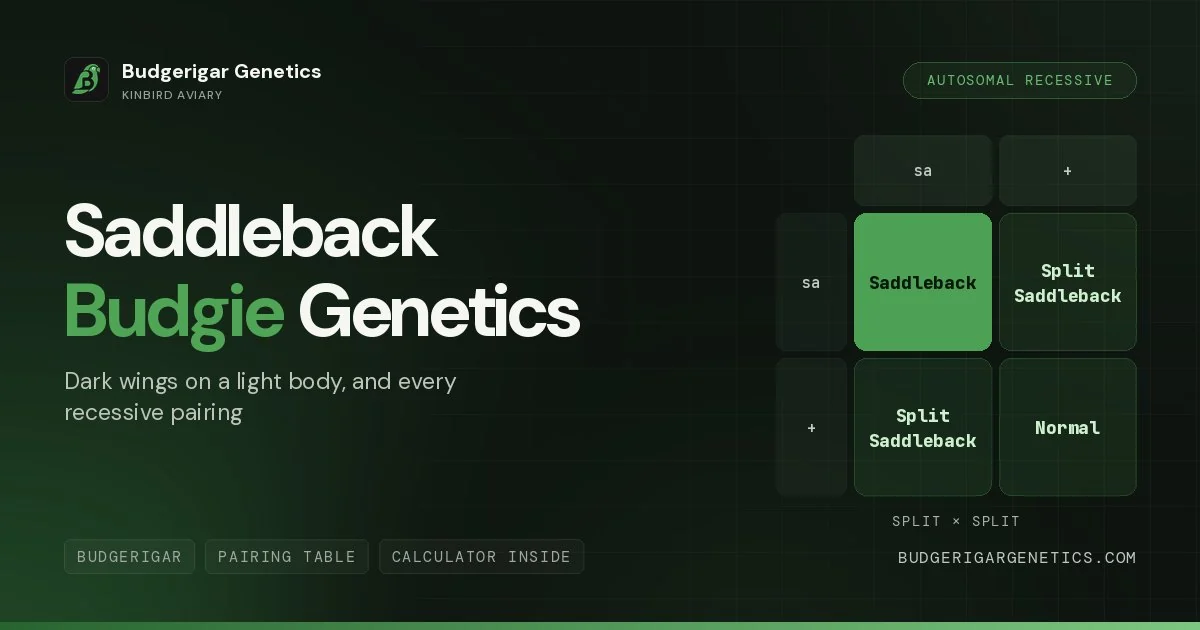
Split × Split produces 25% visual + 50% split + 25% normal at the genotype level (the classic 1:2:1 autosomal recessive ratio), which the calculator collapses to 25% visual + 75% possibly split ('//') because the 50 split and 25 normal chicks are visually identical.
Visual × Normal produces 100% split offspring.
Saddleback combinations
Saddleback combines with most other budgerigar mutations.
Saddleback Opaline combines the wing-reversal pattern with the saddle marking, creates a double-pattern visual signature.
Saddleback Cinnamon produces brown saddle markings instead of dark, softer contrast.
Saddleback Cobalt produces a saddle pattern on a deep blue body. Popular in exhibition.
Saddleback Spangle SF combines reverse wing markings with saddle pattern.
Saddleback Recessive Pied combines two recessive mutations with similar pattern-disrupting effects. Both parents must carry both genes for visual offspring.
Pairing predictions
Visual Saddleback × Visual Saddleback produces 100% visual Saddleback offspring.
Visual × Split produces 50% visual + 50% split.
Split × Split produces 25% visual + 50% split + 25% normal (classic autosomal recessive 1:2:1).
Visual × Normal produces 100% split offspring.
Split × Normal produces 50% split + 50% normal at the genotype level. Both categories look identical (all Normal), so the calculator displays this as 100 percent possibly split, notated '// Saddleback'. Confirm actual carriers by test pairing to a visible Saddleback.
The Budgerigar Genetics Calculator handles all Saddleback pairings with proper autosomal recessive logic and split tracking across generations.
Test Saddleback pairings in the calculator
Try Saddleback × Saddleback at budgerigargenetics.com for the 100% visual outcome.
Try visual Saddleback × split Saddleback for the 50/50 visual/split outcome.
Try Saddleback combined with Opaline, Cinnamon, or other mutations to plan multi-mutation exhibition lines.
Test any pairing at budgerigargenetics.com.
Quick answer
Saddleback is an autosomal recessive budgerigar mutation originating in Australia. It produces a distinctive saddleback marking pattern with the body colour extending only partway down the back, creating a 'saddle' effect.
Saddleback pairing outcomes, cock × hen
Every standard Saddleback pairing and what it produces. Tap Try it to open the exact pairing in the calculator with both parents already set.
| Cock | Hen | Chicks (cocks and hens alike) | Calculator |
|---|---|---|---|
| Visual Saddleback | Visual Saddleback | 100% visual | Try it |
| Visual Saddleback | Split Saddleback | 50% visual, 50% split | Try it |
| Visual Saddleback | Normal | 100% split | Try it |
| Split Saddleback | Split Saddleback | 25% visual, 50% split, 25% normal | Try it |
| Split Saddleback | Normal | 50% split, 50% normal | Try it |
Split chicks look Normal. The calculator lists visual, split and normal chicks as separate rows so you can see exactly what each pairing gives.
Breeder warning
Split birds look Normal. You cannot tell a split Saddleback from a Normal bird by eye, so confirm carriers with a test pairing or a DNA test before you build a line on them.
Frequently asked questions about the Saddleback mutation
Short answers to the most common questions about the Saddleback budgerigar mutation, with statistics, sources, and links to deeper reading.
What is Saddleback budgerigar?
Autosomal recessive mutation. Produces a distinctive saddleback marking where body colour extends only partway down the back, creating a 'saddle' pattern.
Is Saddleback budgerigar rare?
Yes. Limited spread outside Australia. Recessive inheritance plus geographic concentration keeps it rare globally.
How to breed Saddleback budgerigars?
Both parents need at least one Saddleback allele. Visual x Visual = 100% Visual. Split x Split = 25% Visual + 50% Split + 25% Normal.
Sources: Australian budgerigar standards.
What is the Saddleback budgerigar mutation?
Saddleback is an autosomal recessive budgerigar mutation of Australian origin. It produces a distinctive saddle-shaped marking pattern on the wing area through reduced eumelanin in specific wing regions. The body coloration remains normal, the mutation affects only the wing pattern.
How is Saddleback inherited in budgerigars?
Saddleback follows simple autosomal recessive inheritance. Both parents must carry at least one copy of the recessive allele to produce visual offspring. A bird can be Normal, split (carrying one copy invisibly), or visual (two copies). Two visual Saddlebacks produce 100% visual offspring. Two splits produce 25% visual + 50% split + 25% normal at the genotype level, the classic 1:2:1 autosomal recessive ratio, which the calculator displays as 25% visual + 75% possibly split ('// Saddleback') since the split and normal chicks look identical.
Can both cocks and hens be split for Saddleback?
Yes. Saddleback is autosomal recessive (not sex-linked), so both cocks and hens can carry the gene as splits invisibly. This is different from sex-linked recessive mutations where only cocks can be split. The autosomal location means inheritance is identical in both sexes.
Does Saddleback combine with other mutations?
Yes. Saddleback Opaline combines wing-reversal with saddle pattern. Saddleback Cinnamon produces brown saddle markings. Saddleback Cobalt produces saddle pattern on deep blue body. Saddleback Spangle SF combines reverse wing markings with saddle pattern. Saddleback Recessive Pied combines two recessive mutations with similar pattern-disrupting effects.
How rare is Saddleback?
Saddleback is less common than other autosomal recessive mutations like Recessive Pied or Cinnamon. Stable Saddleback lines exist primarily in Australian and dedicated European exhibition aviaries. The mutation has not spread as widely as some other budgerigar mutations, making Saddleback exhibition birds a specialty rather than a mainstream class.
Where can I test Saddleback pairings?
The Budgerigar Genetics Calculator at budgerigargenetics.com handles all Saddleback pairings with proper autosomal recessive logic and split tracking across generations. Test Saddleback × Saddleback, visual × split, or any combination with other mutations to plan your breeding programme.
Predict any pairing instantly
Plan your next pairing in the calculator
Budgerigar Genetics Calculator covering 27 documented mutations. Try the pairings shown in this article instantly.
Open the Budgerigar Genetics CalculatorReferences & Further Reading
- Martin, T. (2002). A Guide to Colour Mutations and Genetics in Parrots. ABK Publications. Standard reference for autosomal recessive Saddleback inheritance.
- Rogers, C. H. World of Budgerigars. Beech Publishing House, UK. Documents Australian-origin Saddleback exhibition lines.
- Wikipedia. Budgerigar colour genetics. en.wikipedia.org/wiki/Budgerigar_colour_genetics.
Related Blog Articles & Guides
Continue reading


Further reading: Inte Onsman MUTAVI Research · Dr. Terry Martin (2002), ABK Publications
Browse by inheritance type: Sex-Linked (6) · Autosomal Recessive (11) · Autosomal Incomp. Dominant (10) · Guides & Tools (10)
© 2026 KinBird Aviary · Written by Ayaan Shohan, Bangladesh · Facebook · More articles · Calculator home · Sister site: Lovebird Genetics